












35th National Recycling Congress • August 5–6, 2026
The 35th National Recycling Congress brought the recycling community together from across the country for two days of ideas, policy, collaboration, recognition and a renewed focus on what comes next.
From East to West, Circularity is Best
The 2026 National Recycling Congress officially concluded August 6 after two days of virtual programming that connected recycling professionals, State Recycling Organizations, local governments, nonprofit leaders, educators, advocates, policymakers and innovators from across the country.
Hosted by the National Recycling Coalition, this year's fully virtual Congress was built around the coalition itself: learning from one another, comparing what is happening in different states and communities, examining emerging policy and market issues, and strengthening the relationships that make national collaboration possible.
Across sessions on zero waste, environmental justice, Extended Producer Responsibility, plastics, food recovery, fundraising, organizational leadership, communications, advocacy and battery safety, one message surfaced repeatedly:
The future of recycling and circularity will not be built by one organization, one sector or one policy. It will be built together.
WEDNESDAY, AUGUST 5
Day One: Expanding the Conversation
Congress Co-Chair Kimberly Carroll-Steward welcomed attendees before Ruth Abbe of Zero Waste USA opened the program. Her keynote helped establish a broader frame for the Congress: recycling is essential, but the material hierarchy begins before the recycling bin, with waste prevention, reduction and reuse.
That theme continued throughout both days as speakers examined not simply how materials are collected at end of life, but how systems can be designed differently from the beginning.
Building Leadership Across State Recycling Organizations
The first of four State Recycling Organization fireside chats paired Tracie Bills, Executive Director of the California Resource Recovery Association, with Melissa Young, NYSAR3 Vice President and Director for Sustainability Engagement at Syracuse University.
Their conversation on Leadership Development Pathways explored the opportunities, challenges and common experiences facing organizations on opposite sides of the country. The exchange reflected the purpose behind this year's Congress theme: programs and political environments may differ from state to state, but many of the challenges faced by recycling leaders are remarkably similar.
Women in Circularity: Advancing EPR
MaryEllen Etienne, NRC Board Member and Director of Market Transformation & Development at the U.S. Green Building Council, joined Andriana Kontovrakis, Director of EPR Solutions at Reverse Logistics Group, for a conversation on the rapidly changing world of Extended Producer Responsibility.
The session connected policy with leadership, career pathways, stakeholder engagement and emerging industry practices while highlighting the growing role of women leading circular-economy initiatives throughout the country.
Learning, CEUs, Grant Writing and Networking
Day One also provided participants a choice of interactive breakout opportunities, including NetZero360 continuing-education programming with Lisa Puckett, a practical grant-writing workshop with Michelle Dehaven of WSU, and an open Get to Know Your Coalition networking room led by NRC Board Member Kristine Kubat.
The format gave attendees something often missing from national virtual events: space to move beyond presentations and make direct connections with others doing similar work.
Environmental Justice, Native Communities and Who Gets a Seat at the Table
Jordan Harvill brought environmental justice and Native community perspectives to the afternoon keynote.
His discussion challenged participants to think about who participates in policy development and decision-making and how recycling and environmental systems can better reflect the people and communities most affected by those decisions.
The message resonated into Day Two, when attendees reflected on the importance of Native voices, people of color and historically underrepresented communities being part of the decisions that shape environmental policy and systems change.
NRC Member Meeting: Building NRC 2.0
Day One also included the 2026 NRC Annual Member Meeting, moderated by Board Chair Jay Bassett.
President Teresa Bradley discussed NRC's values, membership growth and strategic partnerships, while Executive Director Charles Kamenides outlined the organization's continuing evolution toward what leaders have described as NRC 2.0.
At the meeting, NRC reported 22 affiliates and more than 9,000 members, demonstrating the reach of the coalition through its State Recycling Organization network.
Treasurer Martie Solomon delivered the financial report, and the Coalition formally launched the process for its 2027–2029 Board of Directors election.
The Member Meeting also looked ahead to several organizational priorities, including strengthening the Recycling Organizations Council, rebuilding the Campus Council, expanding higher-education programming, returning the Buy Recycled Council and adding greater workforce-development emphasis to NRC's certification work.
Communications & Outreach: Sharing What Works
Bobbi Barnowski, Executive Director of TSWAN, and Mary McClellan, Executive Director of the Carolina Recycling Association, continued the SRO conversation with a look at communications and outreach.
Their fireside chat centered on common communications challenges, successful regional approaches and the opportunity for affiliate organizations to share ideas rather than repeatedly solving the same problems independently.
Battery EPR and Collection Safety
Day One concluded its substantive programming with Marta Keane of The Battery Network / Call2Recycle, who presented findings from the Illinois battery study and examined battery EPR developments, embedded batteries and collection safety.
The discussion highlighted both the policy opportunity and the operational urgency surrounding batteries. As battery-powered products become more common and batteries become increasingly difficult to remove from consumer products, collection systems, recycling facilities and local governments are being asked to manage new safety and cost challenges.
NRC Board Chair Jay Bassett then closed Day One with a synthesis of the day's conversations and a look toward the second half of the Congress.

THURSDAY, AUGUST 6
Day Two: From Ideas to Action
Congress Co-Chair and NRC Treasurer Martie Solomon welcomed attendees back for a second day that moved from organizational capacity to national policy, regional implementation, food recovery, recognition and a closing conversation centered on people, place and relationships.
Strong Movements Need Strong Organizations

Kiersten Hill of Firespring opens Day Two with “Empowering Fundraisers.”
Kiersten Hill of Firespring opened Day Two with Empowering Fundraisers: A Practical Guide to Gain Confidence and Knowledge to Make the Ask! Hill brought nearly two decades of nonprofit management and fundraising experience to the Congress, including more than $20 million raised to strengthen Nebraska's nonprofit sector.
Her challenge went well beyond simply asking for money. Fundraising begins with strategy, story, brand, trust and donor relationships. Hill described a six-stage giving cycle — “the donorations” — in which the ask itself is only one step.
Most importantly, fundraising is not the responsibility of one staff person, development professional or committee. It is an organizational responsibility. For NRC and its network of State Recycling Organizations, that message connected directly to the work of building stronger programs, expanding participation and developing the capacity required to lead change.
Plastics: NRC Members Point Upstream
One of the most consequential sessions of the Congress came from the NRC Plastics Subcommittee. Gary Liss and NRC Board Chair Jay Bassett presented the Subcommittee's national survey findings and Board-approved report, developed under Subcommittee Chair Jeremy Drake.
The work drew 241 survey responses. Of those respondents, 83% rated the impacts of plastic production on the environment, climate and fenceline communities as severe, while another 14% characterized the impacts as moderate.
But the report does more than document concern. It points upstream.
Plastics are increasingly being viewed not simply as a downstream waste-management problem, but as a system-level materials-management challenge rooted in production, consumption and disposability.
The Board-approved recommendations call for development of a comprehensive lifecycle-based Sustainable Materials Management plastics policy emphasizing:
- Source reduction first
- Reuse and refill infrastructure
- Accountable Extended Producer Responsibility
- Truth in recycling and claims integrity
- Clear recycling definitions and standards
- Public-health protections and precaution
- Environmental justice
- Protection of municipal and recycling systems
The message was not that recycling matters less. It was that credible recycling must be part of a larger materials-management system, with transparent claims, proven end markets and policies that do not simply shift costs and risks onto municipalities and communities.
The Subcommittee also emphasized broad governance and engagement, bringing recycling professionals, local governments, environmental organizations, public-health experts, researchers, community representatives, producers and brands into policy development. The complete Plastics Subcommittee report is available through NRC's Reports & Resources section.
EPR Comes to the Heartland
How does producer responsibility move from theory to Midwestern reality? Congress Co-Chair Kimberly Carroll-Steward put that question to Kent E. Holm, Director of Douglas County Environmental Services, and Matthew Howe, Legislative Aide to Nebraska Senator Jana Hughes.
The pair described Nebraska's experience passing its first Extended Producer Responsibility law — a battery stewardship measure — during a roughly 90-day legislative session in 2025. Public safety and property-tax relief proved to be powerful parts of the case: battery fires in trucks, material recovery facilities and landfills generate real costs that local governments and taxpayers otherwise bear.
Their playbook on the road toward January 2028 implementation was straightforward: get every stakeholder in the room, including opponents; maintain a consistent message; and address misinformation quickly.
Producer-responsibility principles can travel from state to state, but implementation still has to reflect local markets, politics, infrastructure and community needs. There is no one-size-fits-all circular economy.
Membership Is More Than a Number
In the membership and engagement SRO fireside chat, Gena McKinley sat down with Brandy Moe, Executive Director of Recycle Colorado, a 200-plus-member organization operating statewide programs with a small staff in a state that passed packaging EPR in 2022.
Patty Overman, President of the Missouri Recycling Association, was unable to join as planned, and the session sent warm wishes her way.
The conversation reinforced one of the Congress's strongest themes: growing membership matters, but keeping people engaged matters more. State Recycling Organizations do not need to solve the same organizational challenges separately. NRC can be the place where they share what works, learn from one another and amplify their collective voice.
Food Is a Resource Before It Is a Waste

Paige Sullivan of Copia during the food waste reduction and recovery session.
Angel Veza of ReFED and Paige Sullivan of Copia connected national data to the operational work of keeping food from becoming waste in the first place.
The scale is enormous: the session cited an estimated $495 billion in annual U.S. economic loss from food waste, while noting that the country's organics infrastructure remains comparatively thin, with roughly 200 full-scale food-waste composting facilities.
Their advice was to measure first and then build a “solution stack.” There is no single answer: prevent what can be prevented, donate edible surplus food, and responsibly manage what remains.
One distinction mattered most: when surplus food is still safe and edible, its highest and best use is feeding people.
THE 2026 NRC AWARDS
Sixteen Reasons to Celebrate

The 2026 NRC Congress Award recipients gather for a virtual group photo.
Day Two also belonged to the people, organizations and communities turning ideas into action. Hosts Christine Kiourtsis and Mehreen Chowdhury recognized sixteen honorees during the NRC Awards Presentation. Even the awards reflected the spirit of circularity, with pieces crafted from upcycled circuit boards by TechWears.
Lifetime Achievement in Recycling — Nina Butler, Stina Inc.
Recognized for more than a decade producing the annual post-consumer plastic recycling study relied upon by governments, industry and NGOs.
Recycler of the Year — Ayodeji Oluwalana, Penn State University
Leads one of the nation's largest campus programs, serving approximately 85,000 students, and secured $2.3 million to upgrade composting infrastructure.
Bill Heenan Emerging Leader Award — Juan Martinez, Salt Lake City International Airport
Built an airport-based glass recycling loop that has diverted 147.7 tons since 2024.
Beth Brown Boettner Award for Outstanding Public Education/Outreach — Chicago Regional Recycling Education & Outreach Partners
The partnership brought together 275 local governments behind “Feed the Cart,” described during the ceremony as the largest recycling education campaign in Illinois history.
Fred Schmitt Award for Outstanding Corporate Leadership — Community Waste Disposal (CWD)
Honored as a corporate partner advancing recycling well beyond basic compliance.
Outstanding Recycling Innovation — Renewable Recycling, Inc.
Recognized for turning difficult-to-manage materials into valuable resources through an expanding regional network.
Outstanding K–12 School Program — Outagamie County Recycling & Solid Waste, “ABC's of Recycling Right”
The program delivered 800 books free to schools in Brown, Outagamie and Winnebago counties in Wisconsin.
Outstanding Not-for-Profit Business Leadership — Recycle Utah
Celebrating 35 years of work while planning a new community sustainability hub on more than four acres near Park City.
Outstanding Community or Government Program — Keep Allen Beautiful, Allen, Texas
Recognized for engaging tens of thousands of residents and achieving strong event diversion results.
Outstanding Market Development — City of Allen / Keep Allen Beautiful
Used the city's large USA Celebration to engage a 60,000-person audience in recycling and introduced reusable cups at another community event.
Outstanding Diversity Leadership — MaryEllen Etienne, Women in Circularity
Honored for building a platform that connects, celebrates and advances women working across the circular economy.
Outstanding Minority Leadership — 4MyCity Inc., Christopher Dipnarine, Founder & CEO
Recognized for the Baltimore-based “Zero Waste to Zero Hunger” model linking food recovery, composting, workforce development and hunger relief, with staff hired from the community it serves.
Outstanding Public Education & Outreach Program — Zero Waste Strategies Inc., Stacy Savage
Honored for two decades of translating complex waste issues into practical campaigns for businesses, universities and communities.
Outstanding Elected Leader — Honorable Mayor Curtis Cornelious, Little Elm, Texas
Recognized for making recycling a visible part of community leadership and identity.
Tribal Recycling Award — Nez Perce Tribe Solid Waste & Recycling Program
The program has recycled more than 360 tons since 2015 — approximately 720,000 pounds of material.
Tim McClure Award for Outstanding Corporate Leadership — City of Greenville, South Carolina
Recognized for a replicable municipal model that embeds recycling, diversion, infrastructure, outreach and data into community operations.
Each honoree represents the persistence, partnerships and problem-solving that move recycling forward. Congratulations to every recipient and nominee — and thank you for the work behind the recognition.
“I see recycling as more than diverting waste or materials from the landfill. It's about building resilient communities, advancing the circular economy, and leaving a better world for those that come after us.”
— Ayodeji Oluwalana, Penn State University, 2026 Recycler of the Year
Policy, Advocacy and the Power of a Coalition
Fresh off her own award, Stacy Savage moderated the final SRO fireside chat with Adrian Hernandez, Executive Director of the State of Texas Alliance for Recycling, and Tony Rios, President and CEO of the Coalición de Reciclaje de Puerto Rico.
Their discussion asked how organizations can build coalitions around difficult issues, translate local experience into stronger policy and give state and territorial voices greater national reach.
Hernandez discussed Texas's TRIED initiative, which brings economic-development partners into conversations about the logistics and economic opportunity of material recovery. His argument was that recycling organizations must demonstrate value to industry partners rather than simply treating them as adversaries.
Rios described Puerto Rico's effort to develop more on-island end markets and sorting infrastructure as part of a push toward a 60% diversion goal. Their shared request of NRC was equally important: help establish stronger national standards for metrics and reporting and carry the coalition's voice into federal conversations.
The answer that surfaced throughout the Congress was not simply better legislation. It was better relationships.
People. Place. Land.

Jenny Wendt of the MidAmerica Clean Future Alliance delivers the closing keynote from Berlin.
Calling in from Berlin, closing keynoter Jenny Wendt, Executive Director of the MidAmerica Clean Future Alliance, brought the Congress back to the community level.
Her Mississippi River Plastic Pollution Initiative — launched with the UN Environment Programme, the University of Georgia and the National Geographic Society — gathered approximately 130,000 to 150,000 data points along the river and then followed the challenge into rural communities in the Delta, including Blytheville, Arkansas, and Greenville, Mississippi.
In communities that had little or no recycling access, the work started simply: source-separated bottles and cans, repurposed existing buildings, local circularity coordinators and connections among assets that were already present.
Her central lesson was that a community is not an empty space waiting for an outside solution. It already has assets, knowledge, relationships and people doing the work.
“Community, community, community. I'm not going into Greenville, Mississippi telling them what I want them to do. We're listening to what they want done.”
Are We in the Right Relationship?

NRC Board Chair Jay Bassett brings the 35th National Recycling Congress home.
NRC Board Chair Jay Bassett closed the Congress by bringing two days of presentations back to three words: people, place and land.
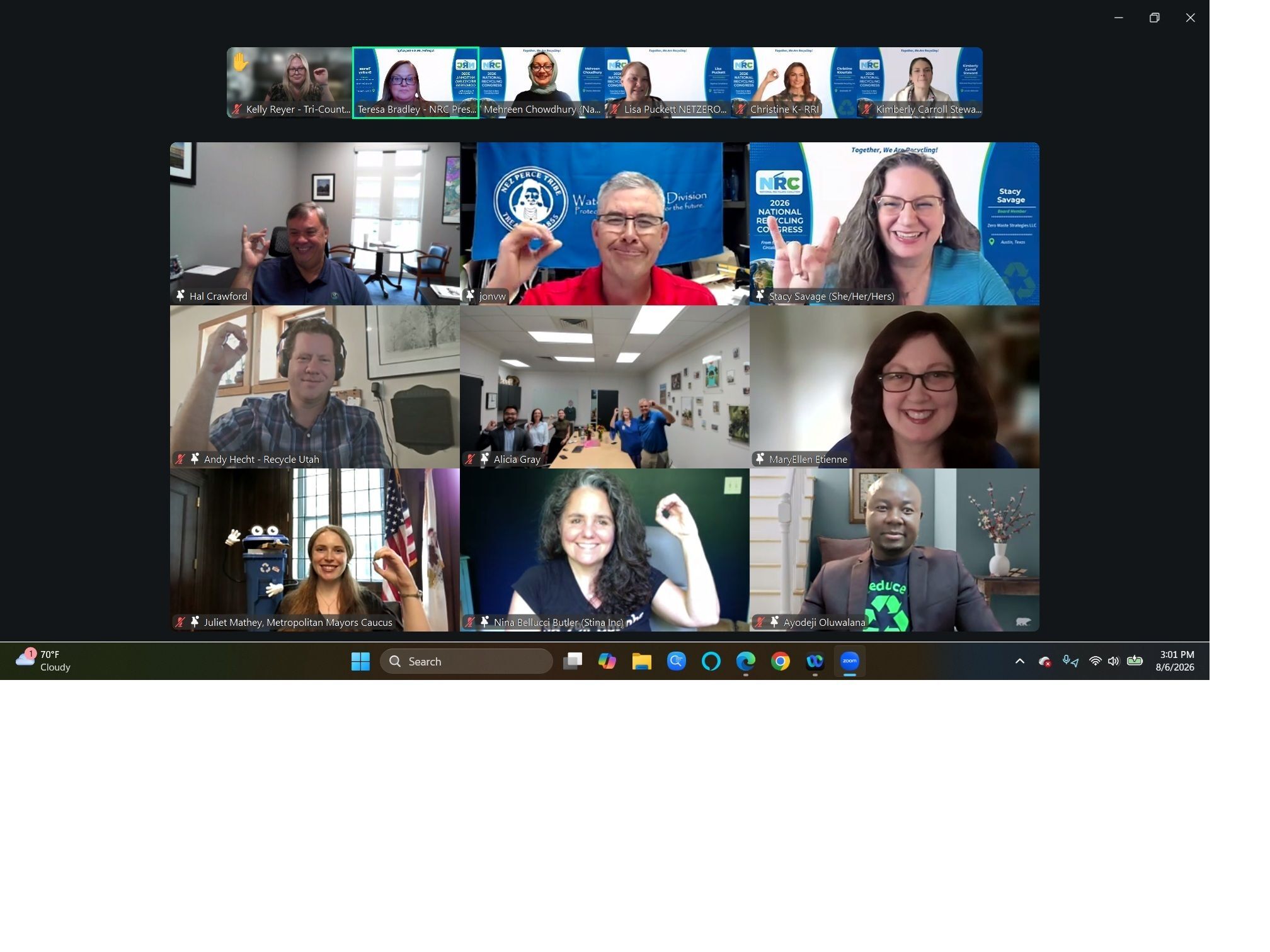
He asked participants to switch to gallery view and look at the people gathered on screen. Drawing on Lifetime Achievement honoree Nina Butler's question — are we in the right relationship, with each other, with the land and within our organizations? — Bassett answered that, in that moment, the coalition was.
He pointed to a year spent intentionally building those relationships: stronger connections among State Recycling Organizations, policy workshops, the Plastics Subcommittee work and the Recycling Organizations Council. He also looked ahead to NRC's 50th anniversary in 2028 and the opportunity to celebrate that milestone together.
“It is us, and we get to decide, and we get to move forward together.”

The view Bassett asked everyone to take in — one coalition, together in gallery view.
From Congress to What Comes Next
The 35th National Recycling Congress was not simply a review of where recycling stands in 2026. It also offered a glimpse of where NRC is heading.
NRC leaders outlined work underway to strengthen relationships with State Recycling Organizations, expand stakeholder engagement, develop policy, rebuild councils and create new opportunities for members to participate.
Among the next steps:
- Strengthening the Recycling Organizations Council with additional programming for State Recycling Organizations.
- Re-envisioning the NRC Campus Council.
- Convening the inaugural Higher Education Summit on October 29, 2026.
- Bringing back the Buy Recycled Council.
- Expanding the National Standards Certification Board with a workforce-development focus.
Bassett also looked farther ahead to 2028, NRC's 50th anniversary, and the opportunity for the coalition community to celebrate five decades of national recycling leadership.
The direction is increasingly clear: national perspective informed by state and local experience; policy informed by practitioners; recycling connected to reduction, reuse, organics, product stewardship and sustainable materials management; and a stronger coalition tying those pieces together.
COMING SOON
2026 Congress Recordings
Missed a session or want to watch one again? Recordings from the 35th National Recycling Congress will be posted to the NRC website soon.
Thank You
To our speakers, moderators, award recipients, sponsors, promotional partners, State Recycling Organizations, NRC members, volunteers, Board of Directors, Congress Planning Team and everyone who joined us from across the country:
Thank you for making the 35th National Recycling Congress possible.
You brought your experience. You shared what is working. You asked difficult questions. You connected with colleagues across the country. And you demonstrated why a national coalition matters.
With Appreciation to Our 2026 Sponsors & Partners
NRC extends its gratitude to the organizations and individuals whose sponsorship and support helped make this year's Congress possible, including Pennsylvania Resources Council, NetZero360, DonifyUSA, Zero Waste San Diego, G2Zero, The Battery Network, Race to Zero Waste, Pearl Accounting Services, CRRA, Stephen M. Bantillo and Professional Recyclers of Pennsylvania, along with our promotional partners and volunteers.
From East to West, Circularity is Best.
Together We Are Recycling!
National Recycling Coalition